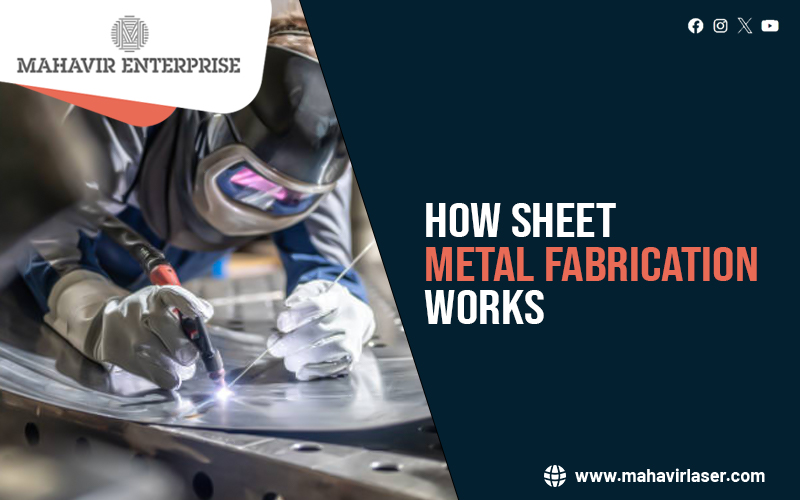
Sheet metal fabrication is a primary stage of turning raw material into finished products. From kitchenware to submarines and rockets, sheet metal fabrication is used in diverse industries for versatile applications. This blog will explain to you everything you need to know about sheet metal fabrication.
Metals Used for Metal Fabrication
Each of the metals offers different properties of strength, corrosion resistance, malleability, ductility, etc.
Stainless Steel
Stainless steel is highly durable and corrosion-resistant. It is known for its strength, aesthetic shiny finish, and ability to withstand moisture and chemicals. Its inertness makes it ideal for making food processing units and medical instruments.
Also Check: Metal Fabrication Service Vadodara & Metal Plasma Cutting
Galvanized Steel
It is simply the stainless steel coated with a protective layer of zinc to prevent rusting. Its quality to be highly resistant to temperature and moisture makes it a prime choice for outdoor structures, ductwork, roofing and fencing.
Carbon Steel
It is a type of steel with rich content of carbon. This makes it more strong but turns it less resistant to rusting. It is mainly used in bridges, pipelines, heavy machines, and automotive frames. Carbon steel is appreciated for its strength and cost=effectiveness, however, it require surface treatments to be resistant to rusting.
Aluminium
It is a lightweight, non-corrosive, and non-magnetic metal. It is ideal for making aerospace components, car bodies, signage, and electronics because they are easy to bend, weld, and shape. It is not as strong as steel, but its resistance to corrosion makes it indispensable.
Copper
Copper is known for its excellent thermal and electrical conductivity. It is soft, malleable, and corrosion resistant, making it ideal for electrical wiring, plumbing, roofing, and decorative items. It also carries unique anti-microbial qualities, making it suitable for use in healthcare equipment.
Brass
Brass is an alloy of copper and zinc, prized highly for its gold-like appearance, ease of workability, and corrosion resistance. It is commonly used in decorative fittings, musical instruments, and plumbing fixtures. It does not catch fire, making it ideal to use in fire-prone areas. It is even resistant to saltwater; therefore, it can be easily employed in marine plants.
Titanium
Titanium is a strong, lightweight, and corrosion-resistant metal, especially to saltwater and chemicals. Although it is really expensive and difficult to work with, it is used in aerospace, medical implants and military equipments. It is popular as it can withstand extreme temperatures and environments.
How Sheet Metal Fabrication Works
Designing
This is the foremost task of metal fabricators to design a 2D or 3D sketch/model of the cutting. Before manufacturing, dimensions, use, and specific finishing are all laid out on a map. This is either done by CAD or manually.
Cutting
For cutting, CNC laser cutting is considered one of the most precise and accurate cutting techniques. It is controlled by G-code and offers high precision in cutting, generating minimal waste.
Bending
This is the process of obtaining the desired curve in the sheet. It is also known as CNC folding and can be done by a manual press brake or an automated panel bending machine.
Forming
This procedure forms, deforms, or reshapes the material into the desired shape without decreasing its mass.
Welding
Welding is one to joins and cures two parts of metal using high heat. Many welding methods are used for sheet metal fabrication, such as metal inert gas welding, tungsten inert gas, robotic MIG welding, or spot welding.
Finishing
This as the name suggests the last step in Metal Fabrication. It increases the aesthetic appeal of the sheet, adds a shine and smooth look. This is done by surface treatment, deburring, cleaning and polishing.
Assemble
At last, the ready parts are assembled and packed for delivery.
Sheet metal fabrication is an integral part of the steel industry. It is widely used in aerospace, automotive, textile, and water treatment plants, vending machines, construction, and many other industries. Therefore, it is essential to understand the steps included in metal fabrication.
Conclusion
Get in touch with the best provider of CNC laser cutting service in Vadodara – Mahavir Enterprise. We provide advanced sheet fabrication techniques like CNC bending, CNC plasma cutting, CNC sheet metal cutting, etc. Let us know your query, and we will ensure you get the best services from us. Contact us for more information.
Also Read: What Makes Plasma Cutting Ideal for Thick Metal Sections?